What if…consent helped us care for ourselves and others?
This is the first article in an ongoing series called “What if…” that explores the questions that have led RISE to innovative new ways of approaching sexual health education.
Consent is usually taught in the context of sex and dating. For years, consent models have used cups of tea, french fries, checklists, and other tools to help people understand that in sexual situations they should ask before acting, listen carefully, and respect another person’s answer.
That matters. A lot.
But at RISE, consent is a bigger conversation. Consent is not only about what we receive from others. It is also about what belongs to us. And consent shows up in every kind of relationship: friendship, family, classroom, workplace, faith community, healthcare setting, and romantic or sexual relationship. Any time our values, bodies, time, attention, energy, stories, space, feelings, or choices are involved, consent matters.
So RISE asked:
What if practicing consent helped us care for ourselves and others?
That question helped shape the MOONS of Consent.
Most consent models focus on, “How do I know whether someone else has consented?”
MOONS gives us another way in. It focuses on both:
What does freely saying “yes,” “no,” or “I don’t know yet” feel like?
What does respectfully receiving “yes,” “no,” or “I don’t know yet” mean?
That shift might sound small, but it changes a lot.
A person might know they should not pressure someone else, but still struggle to notice when they are being pressured.
They might know silence is not consent, but still worry about the consequences of saying “no.”
They might understand consent in theory, but still have trouble asking for—or giving someone—time to make a decision.
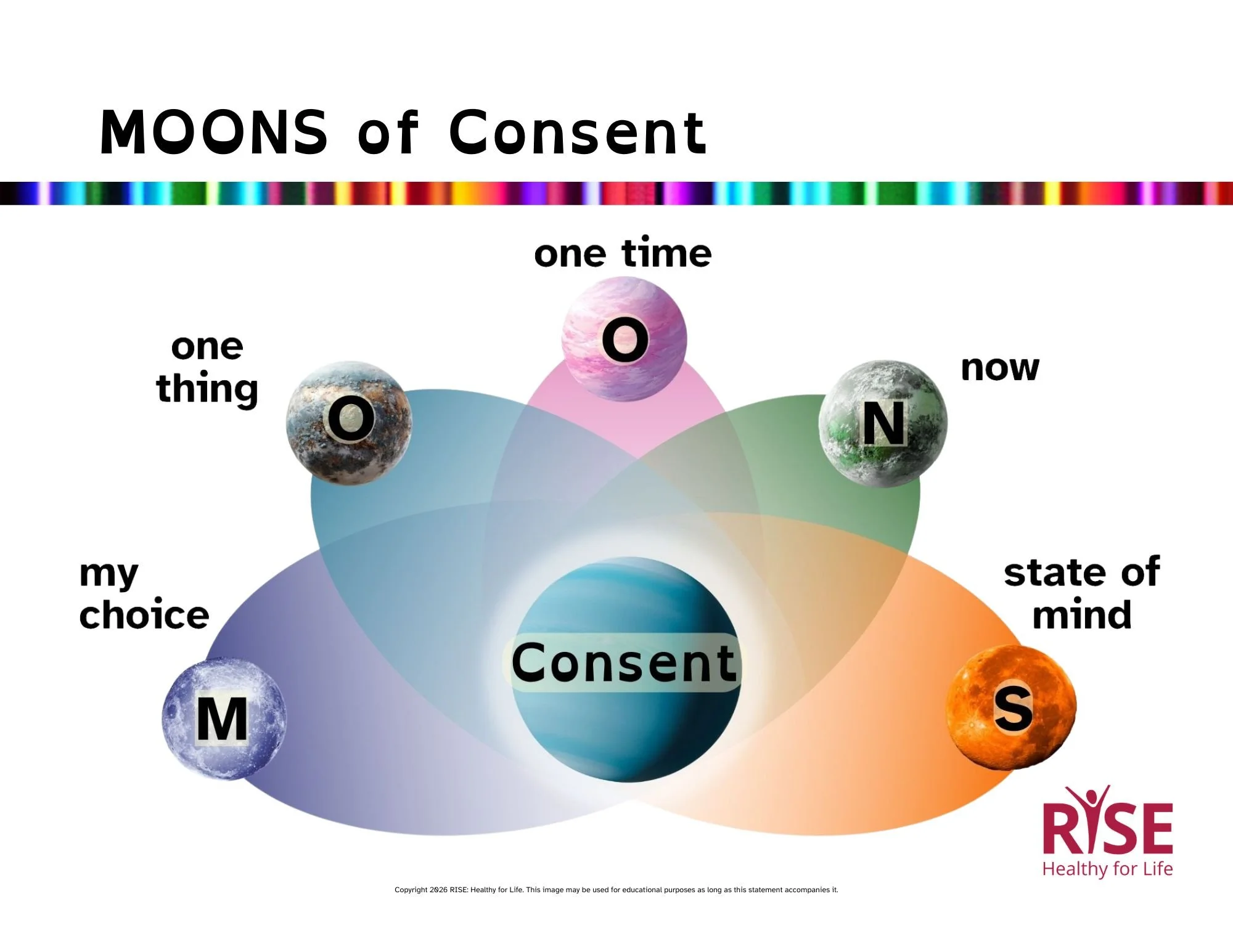
Click image for a PDF handout with the graphics and descriptions.
MOONS stands for:
My choice, my body, my action: I want to do this. Nobody talked me into it. This choice feels safe.
One thing: I am giving consent for this specific thing.
One time: I am giving consent for this specific time.
Now: I am giving consent right now, and I can change my mind at any time, for any reason or no reason.
State of mind: I might feel nervous, but I am alert and awake. I can decide whether I want to do this, and I can keep deciding.
If any of the MOONS are missing, it is not consent.
In any relationship, from friends to colleagues, romantic partners to fellow congregants, both people should be in charge of their own actions and responsible to each other.
MOONS still teaches people to ask before acting, listen without arguing, and respect a “no” without making someone pay for it emotionally. It also encourages conversation. People can talk about what matters to each of them, what they enjoy, what specifically they are agreeing to, and whether they are both in a healthy state of mind to make a decision together.
MOONS helps us ask:
What am I entitled to? Respect, consideration, and feeling safe.
What belongs to me? My values, body, time, attention, energy, stories, space, feelings, and choices.
What am I responsible for? My own words and actions.
What does respect feel like? It feels like not having to justify my answer. It feels like being considered and valued, especially when my answer isn’t what the person hoped for. It feels like being believed even when my experience is different from theirs.
Consent is an ongoing conversation, and checking in is part of it. Checking in means paying attention to tone, body language, silence, hesitation, and changes in energy. It can mean saying things like, “How are you doing?” “Do you need time to think about it?” “It’s OK to change your mind” or “Do you want to talk about it?” Checking in shows care and respect—between friends, among family, and with partners.
Consent is about more than preventing the worst things from happening. It is about building healthy relationships where people can be their whole selves. Practicing consent is a way to care for ourselves and others in any relationship.